

Fox
A territorial forest resident that warns, drives intruders away and hunts hares.

A resident with familiar paths
A fox lives in a connected territory in the forest. Its paths follow clearings and passable undergrowth. By day it strolls through the woodland, pausing to rest in a sheltered place before setting out again. At dusk and through the night its pace quickens, its rests become shorter and hunting more likely. Rain makes it rise, return to its sheltered resting place if needed, and wait there awake until the shower eases.
Warning and eviction
Even a resting fox notices slimes in the nearby territory. A brief observation usually leads to a growled warning; continued approach is answered with bites. Anything that startles it, suddenly stands beside it or rushes in is attacked without warning, and sometimes the fox simply skips the warning out of temper. Deer, boars and small shore-dwellers are left unharmed, but the fox steps aside when they come too close. If attacked by a slime or another fox, it defends itself without a warning first, but retreats when clearly outmatched.
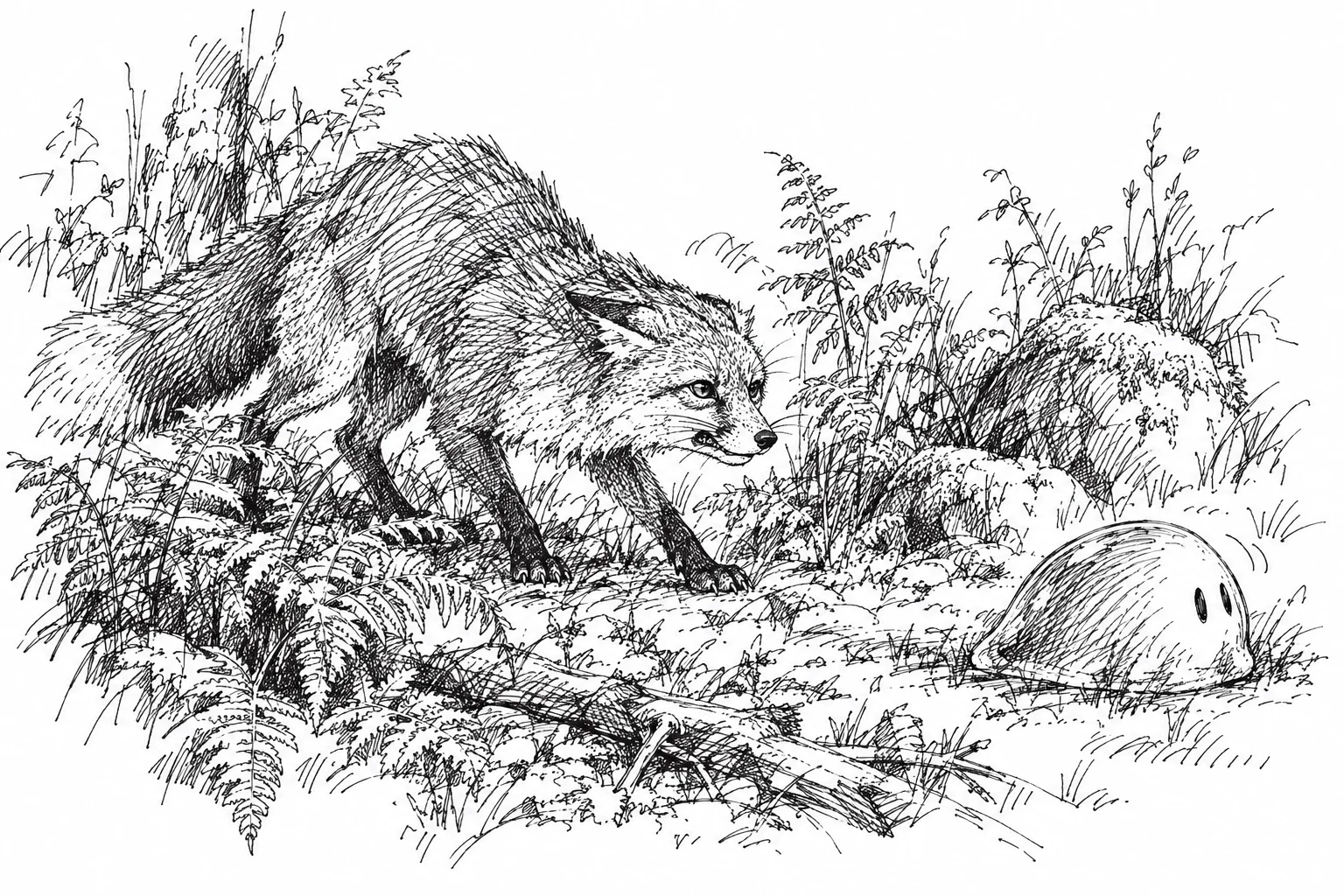
Ink study · First the growl, then the bite.

The growl came from the ferns before I saw the fox. The forager turned back, and the fox stood still until it had vanished among the trees.
When it lets go
An intruder that withdraws during the warning is usually left alone. Retreat can end an eviction even after an attack: the fox pursues only a short distance from the original confrontation, stopping at the territory boundary or after a brief chase at the latest. It then stands its ground and attacks a slime that stays close once more. After a few attacks it gives a little ground; whatever follows or attacks it then puts it to flight. If the intruder withdraws, the fox patrols on alertly instead of lying down at once. A lone Aqua is badly outmatched in direct combat; several nearby slimes can make the fox retreat. Wounds, exhaustion and superior dangers limit its courage.
After a conflict
Immediate disturbances wake the fox even during a lull after conflict. It confronts a lone slime even while still recovering from a conflict. It only seeks distance when badly wounded, severely exhausted or outmatched; if only a single slime keeps following it after fleeing a superior group, the fox eventually turns to face it. Outside its own territory it calmly gives way to slimes instead of confronting them. After fleeing, it initially recovers where it has escaped to, instead of immediately returning to a possible conflict at its resting place; it first stays alert on its feet before lying down.
At the territory boundary it can still bite back against an attacker in immediate contact. Once the attacker withdraws, the fox does not follow it across the boundary. A slime lingering just beyond the boundary is growled at, but not pursued.
Hunts and breathing room
A rested hare is faster than its pursuer. Both spend stamina during a prolonged sprint; only severe exhaustion slows them sharply. Some hunts therefore end without a catch. A captured hare is eaten whole, leaving no collectible carcass. After a short feeding pause, the fox does not hunt again for a while. Slimes may die during an eviction, but the fox does not eat them. Rest restores stamina; after undisturbed recovery its wounds also begin to heal.
The fox does not step away from hares as it does from unfamiliar neighbours. When it has just eaten or needs recovery, it lets nearby prey pass. A short sidestep to give another peaceful animal room does not end its rest or feeding pause; it resumes the activity afterwards.
Boundaries between neighbours
The woodland paths of neighbouring foxes can overlap. They watch and threaten one another, or fight briefly before one gives way. A territory is no invisible wall: its resident can cross the boundary, but returns to familiar places after a hunt or flight.
An empty place in the forest
A slain fox leaves a substantial carcass. Its territory remains empty for a long time. Only later may another animal arrive from a forest edge, provided the resting place and entrance still belong to the forest. If another biome has spread over them, the territory is not repopulated. The previous individual never returns. Slow forest hare immigration follows its own rhythm, independently of a fox territory being reoccupied.