


Reading dominance and time of day
The orb in the upper band combines the colonies' relative strength with a clock for the current day–night cycle.

The inner dominance view combines three observable measures: living population, explored ground and the number of existing nests. For each species, population and exploration are first considered as shares of the world's known overall state. Its number of nests strengthens this base value; the resulting values are then compared with one another.
The medallions identify each species, not only the leading colony. Clicking a medallion opens that species' Bestiarium entry. A larger drawn area means greater relative weight, not more occupied tiles.
Four examples of the same HUD display · fixed demonstration values, not a current save.
How the balance is formed
Nests shape the result more strongly than an equally large, short-lived difference in population. Exploration also counts, but can only grow, making it a subtler long-term trace. A species with no nest remaining receives no area of its own, even if some of its creatures still roam.

After a distant nest fell, every other colony's share grew a little, although none had just gained a new slime.
A picture in motion
The areas move smoothly towards new values. A birth, death or newly explored stretch therefore does not change the image in a hard jump. Only after a little time does a shift become clear.

A birth barely moved the boundary at first. A few moments later the new balance was plain to see.
The clock around the edge
The outer ring represents a full day–night cycle. Midnight is at the top; from there a warm, bright segment grows clockwise to show the time since midnight. The remaining black segment extends to the next midnight.
Two tick marks show sunrise and sunset. The moving boundary between light and black tells how much of the present day or night remains. Hovering over the orb also names the current phase of the day.

The bright edge drew near the sunset mark. Before it reached it, the first Gloom were already on their way.
What the orb does not claim
The display measures neither fighting strength in a particular encounter nor stores, health or unknown ground. It is a smoothed picture drawn from three known sources, not an immediate order or a victory condition on its own.
1 · Species and areas
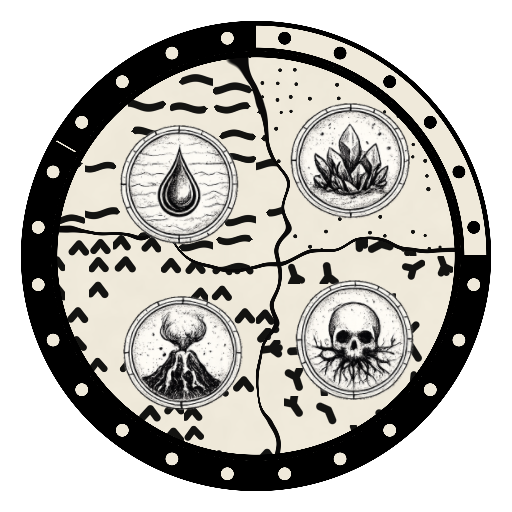
The droplet, skull, volcano and crystals identify Aqua, Undead, Magma and Gloom. Their matching patterns distinguish the areas without colour. In this example, the balance is even.
2 · Aqua gains ground
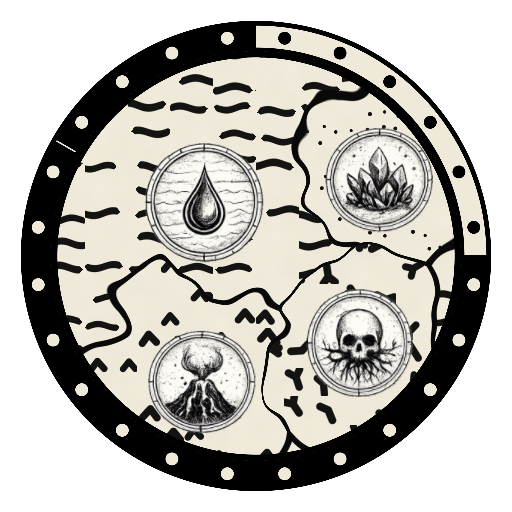
In the second example, Aqua occupies more of the orb. Nests, population and exploration determine its weight relative to the other species. These boundaries are not a map of occupied terrain.
3 · Noon
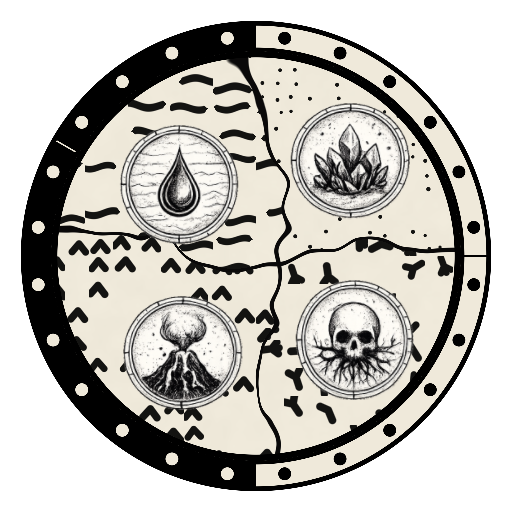
The bright clock segment begins at midnight at the top and grows clockwise. At noon, the right half is bright and the left half is black. The dots divide the ring into 24 equal time intervals.
4 · Sunset
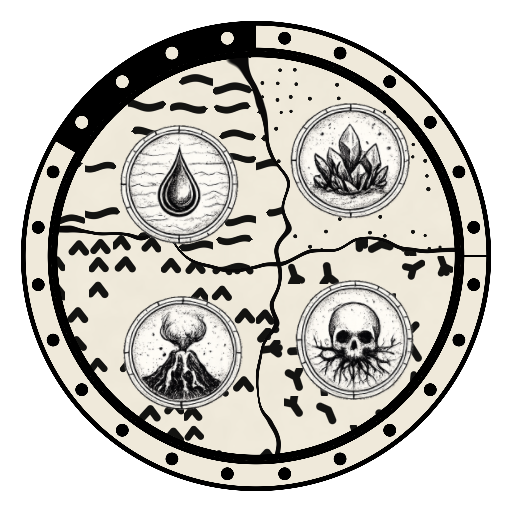
Two tick marks indicate sunrise and sunset. Here the bright segment reaches the evening mark; the remaining black segment shows the time until midnight, not the whole night.
