


Earthworm
A solitary digger reshapes the underground without distinguishing earth, supplies or colonies.
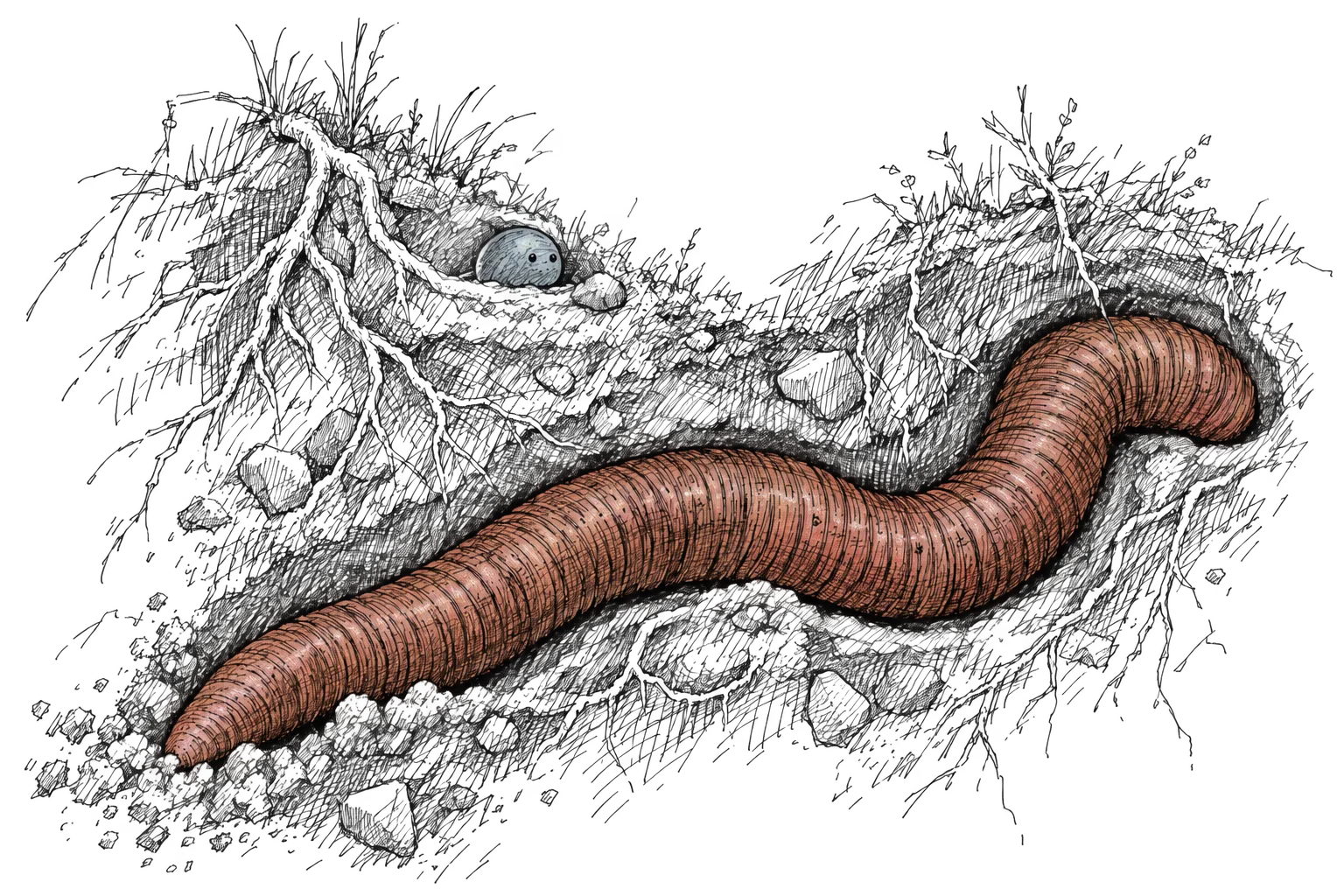
The snug passage follows the body. An Aqua in the neighbouring cavity gives a sense of scale.
Stretch, brace, draw forward
The great earthworm pushes its front rings into the soil, braces itself, then draws the rest of its body forward in a travelling wave. Its passage hugs the thick, reddish-brown skin.
A path of its own
In free worlds, the solitary earthworm arrives after some time has passed. Its head emerges from an existing wormhole, followed by the body rings and finally the tail. Before that arrival it digs no passages in the world. Once it dies, no successor appears.
The earthworm lives below ground. It digs for a while, rests, then continues with irregular changes of direction. Existing chambers lie on its path just as solid earth does. Even at rest, small movements remain visible in its body rings. Neither a queen nor a colony boundary guides its steps: it neither seeks slimes nor avoids them.
Whatever the body runs over
Whatever its body actually runs over is at risk. Slimes may be injured, and queens receive no protection. Dropped food and nectar parcels can be crushed; stones and obstructing luminous objects can be destroyed during a breakthrough. Supplies beside its track remain where they are. While it rests, the stationary body causes no further contact damage.
An earthworm can be attacked, but its resilient body makes it a formidable opponent for a lone slime. Even under attack it keeps following its own route. A nearby colony may respond with a limited group if it hurts members or comes close to their queen. Mere presence far from the chamber does not trigger a general attack.
Traces in the soil
Its tunnels stay open after it moves on. During rain it tends upward from deeper ground. Occasionally a short shaft then reaches a clear spot on the surface. The hole remains a usable entrance while the earthworm itself turns back underground. Digging exposes enclosed resources without harvesting them. Natural nectar parcels in the forest underworld can also be crushed under its body. Strong vibrations usually wake sleeping animals before its body reaches them. Close to their roost they may briefly defend it, but soon let the intruder go. If digging removes their ceiling, they seek a new resting place nearby. Once airborne, they are beyond its reach.
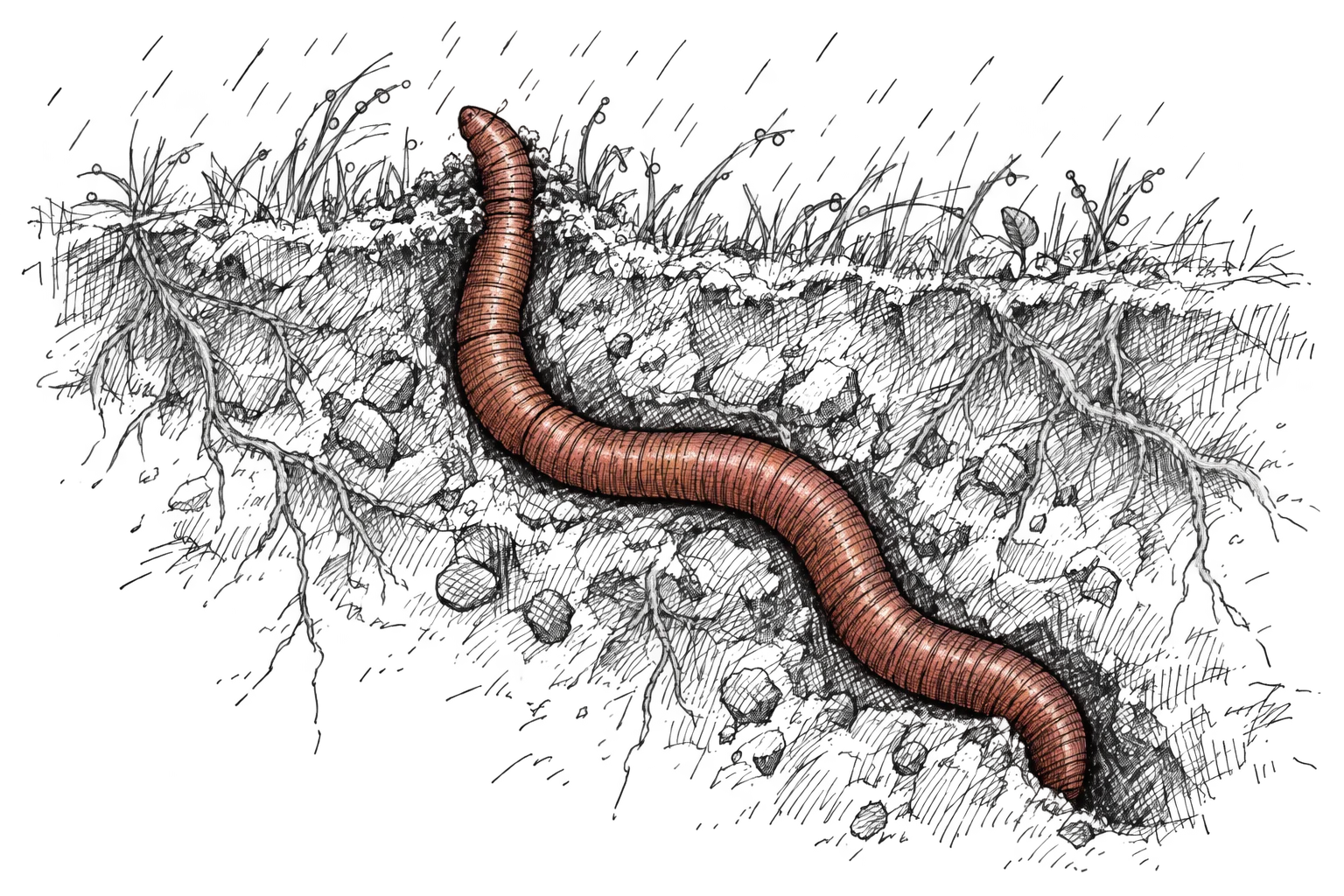
Rain study · The head reaches the surface; the hole remains.
Growing at rest
As the animal ages, it adds body rings during its rests. A young worm starts with 8 body segments; a fully grown one can have 14, plus its head and tail. Its longer body becomes tougher and provides more food after death. Each ring crumbles into one to three smaller parcels; their number divides the segment’s nutrition rather than multiplying it.
Passages between worlds
Rarely, its digging continues as a connection between underworlds, including the forest underground. Its head vanishes into the wormhole first, followed by the rings and finally the tail. At the far end the head is already crawling onward while the rest of the body follows. While the animal is drawing itself through the connection, it can neither be hit nor injure slimes by contact. Its usual physical effects resume afterward. The connection remains usable in both directions, even if the earthworm later dies.
After death
Exactly one earthworm inhabits a newly formed world. It has no colony to replenish it; its death ends that animal’s digging. The tunnels it has already created remain.
Once the animal is finally overcome, its entire body remains in its last curved pose. The pale carcass blocks the slimes’ passage. After 45 seconds, it begins to turn into collectable food parcels, one ring after another. As the rings crumble, the ground they covered becomes passable again. Each parcel lies where the head, body or tail had rested. A larger group may gain substantial supplies at considerable risk.